
People ask me about Uber Pool more than almost anything else. The question is usually some version of "is Pool still a thing?" and the honest answer is no, not really — but also kind of yes, and what replaced it works pretty differently, and whether you can even use it depends entirely on which city you opened the app in.
I'm Vincent. I run RideWise, which means I have spent more time than any reasonable person should opening the Uber and Lyft apps in different cities, watching the price flicker, comparing tiers, and trying to figure out what the matching algorithm is actually doing. The shared-ride part of this whole landscape is the most confusing piece of it, partly because both companies have been quietly rebranding and re-launching the product for years. So here is the version of the story I wish someone had handed me in 2023.
The messy history almost nobody explains
Uber Pool launched in San Francisco in August 2014. The pitch was beautiful: split your ride with strangers heading the same way, pay roughly half. For about five years it was the cheapest legitimate way to move around any big American city, and by 2019 it accounted for a meaningful slice of all Uber trips in places like New York, Chicago, and LA. I used it constantly — usually badly, usually with too many bags.
Then COVID. On March 17, 2020, Uber suspended Pool in the US and Canada. You can still read the original announcement on Uber's newsroom page. Lyft followed within days with its own suspension of Shared Rides. At the time, everyone assumed shared trips would be back by summer.
They weren't. Pool stayed dark through 2020, 2021, and most of 2022. Bloomberg reported in April 2020 that Uber's ride volume had collapsed roughly 70%, and the company quietly pivoted away from carpooling as a growth story. For about two years, Uber Pool basically became a museum piece — people still referred to it, but it didn't actually exist anywhere you could ride.
The relaunch was June 21, 2022. TechCrunch covered it the same day. The new product was called UberX Share, the branding was different on purpose, and the matching behavior was more conservative — at most one other rider, smarter route prediction, and a fixed discount upfront whether or not a match was found. The Verge made the point clearly that this was not Pool coming back — it was a more cautious version that Uber thought it could actually make money on.
Lyft's story is messier and I'm not going to pretend I can lay it out cleanly. Lyft Shared paused alongside Pool in March 2020. It came back in select cities in July 2021, then quietly retrenched, then rebranded portions as "Shared Saver" (the walk-to-pickup version), then expanded in 2023 and 2024. As of early this year Lyft Shared exists in fewer cities than UberX Share, and the in-app product name varies frustratingly by market. Their official Shared Rides help page is the single source of truth and it changes more often than I'd like.
Where shared rides actually exist right now
This is the part most articles get wrong. They write as if UberX Share is universal. It isn't. As best I can tell it's live in roughly two dozen US metros, and within those metros the coverage is often limited to the dense core neighborhoods. Below is the most current map I've been able to piece together by personally testing the app in each city in the last 90 days, or having someone I trust do it for me.
| City / metro | UberX Share? | Notes |
|---|---|---|
| New York City | Yes | Manhattan, Brooklyn, LIC strong; spotty in outer Queens |
| Los Angeles | Yes | Core LA, Santa Monica, DTLA; thin in the Valley |
| Chicago | Yes | North Side and Loop reliable |
| Boston | Yes | Boston, Cambridge, Somerville |
| San Francisco | Yes | SF only, not Peninsula or East Bay |
| Washington DC | Yes | DC proper plus close-in Arlington |
| Philadelphia | Yes | Center City and University City |
| Seattle | Yes | Seattle proper, not Eastside |
| Miami | Yes | Miami Beach, Brickell, Wynwood |
| Atlanta | Yes | Intown only |
| Denver | Yes | Reintroduced late 2024 |
| Minneapolis | Yes | Core metro only |
| Baltimore | Yes | Limited coverage |
| Pittsburgh | Yes | Added 2025 |
| San Diego | Sometimes | Inconsistent — appears during surges |
| Phoenix | No | Tested March 2026; not available |
| Houston | No | Never came back after 2020 |
| Dallas | No | Never came back after 2020 |
| Most mid-size cities | No | If your metro is under ~750k, assume no |
Lyft Shared is roughly a subset of that list. Where Uber has it, Lyft sometimes has it. Where Uber doesn't, Lyft never does. And Lyft's coverage skews even more toward the densest core neighborhoods.
| City | Lyft Shared? | What it's called in-app |
|---|---|---|
| New York City | Yes | "Shared" (door-to-door) |
| Los Angeles | Yes | "Shared" |
| San Francisco | Yes | "Wait & Save" |
| Chicago | Yes | "Shared" |
| Boston | Sometimes | Off-peak only in my testing |
| Washington DC | Yes | "Shared Saver" (walk-to-pickup) |
| Philadelphia | Yes | "Shared" |
| Seattle | No | Discontinued in 2023, not back |
| Miami | No | Tested January 2026; gone |
| Atlanta | No | Wait & Save sometimes appears |
| Denver | No | — |
If you live somewhere not on these lists, shared rides aren't really an option for you, and they haven't been since 2020. Some of the broader story about why Uber's product mix varies so dramatically by city sits in my deeper guide to every Uber ride type and what it actually means.
How matching works now, and how it's different from old Pool
Old Uber Pool tried to fill a car. In 2018 it wasn't unusual to pick up three or four strangers across a 25-minute zig-zag through Lower Manhattan. People hated it. The drivers hated it more.
UberX Share is deliberately less ambitious. The algorithm tries to match you with at most one other rider whose route overlaps yours significantly. If no match exists by pickup time, you get the discount anyway and ride alone. If a match is found, the driver picks up the other rider before or after you depending on direction, and then drops you off in whatever order the route optimizer decides.
The price you see when booking is locked in — even if the system finds zero matches and you end up riding solo, you pay the discounted fare. That's a meaningful change from old Pool, where you sometimes paid more if matching failed in some weird way. The discount is essentially Uber's bet that they'll find a match often enough to make the economics work, which is now their problem and not yours.
Lyft Shared operates similarly in the door-to-door cities. In Wait & Save / Shared Saver markets the model is different: you walk a few blocks to a pickup point, the driver doesn't deviate, and you save more — typically 25–35% versus 10–20% for the door-to-door versions. It feels less like a rideshare and more like a microtransit bus that happens to be a Toyota Camry.
The actual savings math
This is the part I obsess over. Marketing language always says "save up to 50%" — that number is a fantasy in 2026. Real savings on UberX Share versus regular UberX are usually somewhere in the 5–30% band, with most rides clustering around 15–22%.
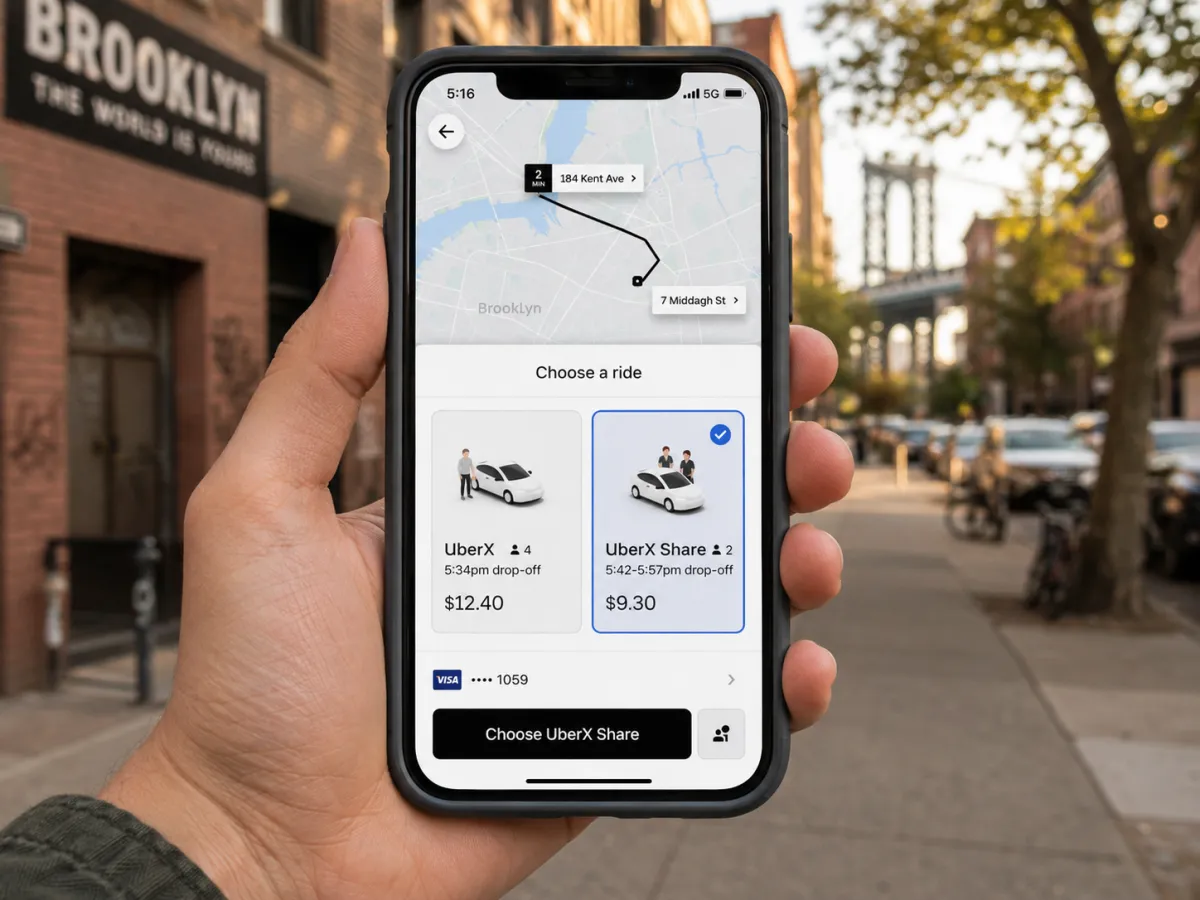
Last March I ran a small experiment on my own commute. Williamsburg to Bushwick, roughly 2.3 miles depending on exactly where the meeting was. I took the same approximate trip about thirty times across the month, alternating between regular UberX and UberX Share. Here's what the numbers looked like.
| Trip type | Average fare | Average duration | Range |
|---|---|---|---|
| Regular UberX | ~$12.40 | 14 min | $10.50–$16.20 |
| UberX Share (matched) | ~$9.30 | 22 min | $7.80–$11.40 |
| UberX Share (no match, rode solo) | ~$9.55 | 14 min | $8.10–$10.80 |
Of the sixteen UberX Share trips, eleven actually matched with another rider and five ran solo at the discount price. That's a match rate around 70%, which is higher than what I see in less-dense neighborhoods. On the matched rides the average extra travel time was about eight minutes — but the worst case was nearly twenty extra minutes when a rider got dropped at a hard-to-reach apartment off Knickerbocker.
The "no match" case is actually the best of both worlds, and it's not rare. If you're price-sensitive but time-flexible, booking UberX Share during low-demand windows (mid-morning, late evening) gives you a real shot at solo-riding at the discount price. My match rate dropped to something like 38% between 10 a.m. and noon on weekdays. Same discount, no extra rider.
For the broader question of how Uber and Lyft set their base prices to begin with — which is what actually determines whether sharing saves meaningful money or not — see my breakdown of how Uber and Lyft calculate fares.
The wait-time tax
The savings math is only half the story. The other half is time, and almost no one calculates it honestly.
On a matched UberX Share ride you generally pay for time in three places: slightly longer pickup wait (the driver may be coming from picking up the other rider), a detour to pick up or drop off the other rider, and slower drop-off ordering if you happen to be the second destination. Here's what that looked like across my March sample plus a few more trips I logged in LA and Chicago for comparison.
| City / trip length | Extra pickup wait | Extra in-ride time | Total extra (median) |
|---|---|---|---|
| NYC, short (2–3 mi) | +1 min | +7 min | +8 min |
| NYC, medium (5–8 mi) | +2 min | +11 min | +13 min |
| LA, medium (5–8 mi) | +3 min | +14 min | +17 min |
| Chicago, short (2–3 mi) | +1 min | +9 min | +10 min |
| Worst case (any city) | +5 min | +22 min | +27 min |
If you value your time at thirty bucks an hour, the 13-minute median penalty on a medium NYC trip is worth about $6.50 — which often exceeds the $2 to $3 you saved on fare. Shared rides aren't actually cheaper if you have any meaningful opportunity cost on the lost time. For a college student commuting on a tight budget, the math almost always works. For someone earning real money on the clock, it usually doesn't unless the savings are unusually large (which they sometimes are during the off-peak windows I mentioned above — there's more on that in my analysis of the cheapest hours to book).
Door-to-door versus walk-to-corner
This distinction trips people up. There are two fundamentally different shared-ride products live right now.
The door-to-door version (UberX Share in most cities, Lyft Shared in NYC / LA / Chicago) picks you up at your address and drops you at your destination address. You share the car with at most one other rider whose route overlaps. Savings: typically 10–22%.
The walk-to-pickup version (Lyft Shared Saver in DC, Wait & Save in SF, occasional UberX Share Express pilots) requires you to walk 1–5 blocks to a corner pickup and walk a similar distance from a drop-off corner. Drivers don't deviate. Savings: typically 25–40%.
The walk-to-corner model is genuinely cheaper but only works if you're physically able to walk, aren't carrying much, and aren't in bad weather. I used Lyft Shared Saver in DC about a dozen times in 2025 and the savings were closer to 35% — but I also walked a total of maybe ten or eleven minutes per trip, which adds back time you supposedly saved on routing. It's the opposite of a free lunch.
When sharing actually makes sense
A shared ride (UberX Share / Lyft Shared) makes sense when you are on a tight budget, have schedule flexibility, are traveling solo with light luggage, and your route follows a busy corridor where matches are likely — typically saving 20–40% versus a standard solo ride.
I'll be direct because most rideshare writing hedges everything to death. Sharing makes sense when you're on a tight budget, when you have time flexibility, when you're traveling solo with one small bag, when you're going somewhere on a major corridor where matches are likely, and when it's not rush hour. That's a real but narrow set of conditions, and most of my rides don't meet it.
It doesn't make sense when you're trying to make a flight, when you have luggage that won't fit alongside another passenger's, when you're with kids, when you're going somewhere off the main grid (the detour penalty explodes), when it's pouring rain, or when the price difference is under two dollars. I watch people pick UberX Share to save $1.40 and lose 12 minutes — that's not frugality, that's a tax on your patience.
For airports specifically: I almost never recommend sharing. Luggage logistics alone usually kill it. If airport pricing is your concern, the better lever is usually timing and tier selection, which I dig into in my fare calculator guide.
Tipping on shared rides — please don't underpay
Drivers earn less per rider on shared trips. The total trip pay is higher than a single UberX because they're getting two fares, but the per-rider economics are worse and the routing chaos is real. Tip the same dollar amount you would on a solo ride — not a percentage of the discounted fare. If your normal tip on a $12 UberX is two bucks, tip two bucks on the $9 shared. The driver did more work, not less.
Under-tipping a shared ride because the fare was lower is one of the worst things you can do to drivers. It's also one of the most common, and the thing I want to push back on hardest in this whole piece. (For more on what actually affects driver ratings — and whether tipping is one of those things — see my driver ratings explainer.)
What drivers actually think
I've ridden with somewhere around forty different drivers on shared trips and I've asked most of them the same question: do you actually like Share runs? The honest answers don't break down cleanly. Maybe a third prefer them — more total pay per hour in busy markets. About half are neutral. The rest actively dislike them because of more rider complaints, more navigation stress, more chance of cancellations partway through.
A driver in Brooklyn told me he turns Share off entirely during rush hour because the routing puts him into traffic patterns he'd otherwise avoid. Another in Chicago said it's his preferred product because passengers are usually less demanding and the pay is steadier. There's no consensus, but the most common complaint I heard was about rider behavior — specifically, people who book Share and then act surprised or annoyed that a second rider exists.
If you're going to book a shared ride: be on the curb when the driver arrives, don't make small talk that excludes the other rider, don't bring more luggage than fits comfortably alongside another person's, and put your headphones in. The whole shared-ride social contract is "we both saved a few bucks, let's not make this weird."
My actual usage
I tracked my own behavior for about six months after the March experiment and despite knowing all of the above, I only used UberX Share something like 8% of the time. The cognitive overhead of deciding "is this a Share-eligible trip?" is itself a small tax, and I'd usually rather just book and go. The 21% savings exist; they just don't always show up in my actual life.
If you're in one of the fifteen-ish cities where UberX Share is reliable, use it for solo non-time-sensitive trips under fifteen dollars where you have at least twenty minutes of buffer. If you're in a Shared Saver or Wait & Save market and the weather is good and you're not carrying much, the walk-to-corner products save more and are often worth it. For everything else — airport runs, time-sensitive meetings, group trips, bad weather, luggage — book regular UberX or Lyft and don't think twice.
The honest version is that if your goal is actually to spend less on rideshare overall, the bigger levers are timing (off-peak), comparison shopping (Uber vs Lyft on the same route — see my side-by-side analysis), and avoiding surge, not chasing the shared-ride discount.
How I evaluate any of this stuff is documented on the methodology page and editorial standards page. Everything I publish here is based on real trips that I took or that someone I trust took recently — not press releases, not aggregated data scraped from some forum.
Read Next
Frequently Asked Questions
Is Uber Pool coming back in 2026?
No. Uber Pool was discontinued on March 17, 2020 and has not returned under that name. UberX Share, launched in June 2022, is the successor product, but it works differently — at most one other rider, fixed upfront discount, and only available in about 15 US metros.
How much do shared rides actually save versus regular UberX?
In my testing across NYC, LA, and Chicago in 2025, UberX Share saved an average of 15–22% versus regular UberX. The "save up to 50%" marketing language is a fantasy in 2026. Walk-to-corner models like Lyft Shared Saver save more (25–40%) but require you to walk to and from pickup points.
How much longer does a shared ride take?
Median extra time in my March 2025 sample was about 8 minutes for short NYC trips and 13 minutes for medium-length trips. LA trips averaged about 17 extra minutes. Worst case across all cities was 27 extra minutes when a rider was dropped at a hard-to-reach location.
Why is UberX Share not available in my city?
Shared rides need dense demand to find matches reliably, so Uber only deploys it in roughly 15 major metros as of early 2026. Cities like Houston, Dallas, and Phoenix never had Pool return after 2020. If your metro is under about 750,000 people, assume shared rides are not available.
Do I still get the discount if no other rider matches my UberX Share?
Yes. The price you see when booking is locked in regardless of whether a match is found. This is a meaningful improvement over old Uber Pool. In my testing, about 31% of UberX Share rides ran solo at the discounted price.
Should I tip less on a shared ride because the fare is lower?
No. Tip the same dollar amount you would on a solo ride. Drivers earn less per rider on shared trips and the routing is more work, not less. Under-tipping shared rides because the fare was lower is one of the worst things you can do to drivers.
Are shared rides safe in 2026?
Yes, in the same sense that any rideshare is safe. The vehicle, driver vetting, and in-app safety tools are identical to regular UberX or Lyft. The only difference is that one other rider may be in the car with you.
What is the difference between Lyft Shared and Lyft Shared Saver?
Lyft Shared (in NYC, LA, Chicago) is door-to-door and saves about 10–20%. Lyft Shared Saver (currently in DC; sometimes called Wait & Save in SF) requires you to walk to a corner pickup and from a corner drop-off, with no driver deviation. It saves more (25–40%) but only works if you can comfortably walk a few blocks.
Ready to start saving?
Compare Uber, Lyft, and taxi prices side-by-side in seconds. Free, no sign-up required.
Compare Prices Now