
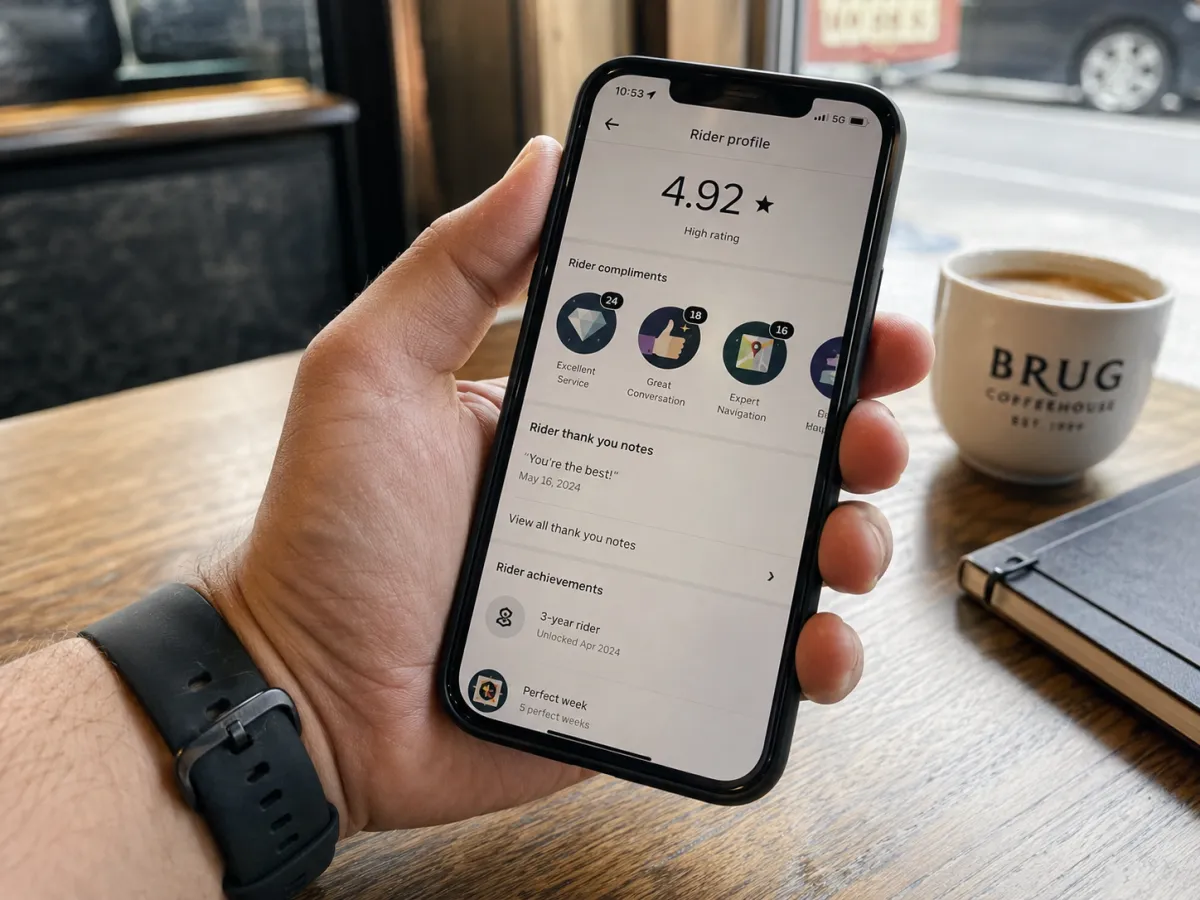
I just opened the Uber app on my couch to check before writing this. My rider rating is 4.92. About a year and a half ago, in late November 2024, it dropped to 4.71 over the course of maybe ten days and I genuinely panicked. I'd been traveling for a wedding in Charleston, taking late-night rides after long flights, and apparently I'd become the kind of passenger drivers quietly punish with three stars. The strange thing about this system is that you only see the average. You never see the individual votes.
I'm Vincent. I've been building RideWise for the last few years, comparing Uber and Lyft pricing across 300+ US cities, and the question I get more often than anything else has nothing to do with prices. People want to know what their rating means, where to find it, whether 4.7 is bad, and whether passengers can actually get deactivated. (Yes. More on that further down.) This is the guide I wish I'd had when my rating tanked.

Why almost nobody is below 4.6
Both platforms launched with the same basic five-star structure. After every ride the driver rates you, you rate the driver, and a rolling average gets stored on each side. Simple in theory. In practice it has turned into one of the most lopsided rating systems in consumer software, because the social default — for both sides — is to tap five stars unless something actively went wrong.
Uber has acknowledged this. In a 2019 blog post about transparency in ratings, the company noted that most riders never look at their rating because they assume it's perfect. It usually is — until it isn't. Once it slips below about 4.7 you start noticing longer driver wait times on busy nights, because some drivers filter low-rated riders out of their queue during surge. I'll get to whether that's technically allowed in a minute.
Here's roughly how rider ratings shake out, based on driver-forum reporting on places like UberPeople.net and what both companies have shared publicly over the years.
| Rider rating range | What it usually means | Approx % of riders |
|---|---|---|
| 4.95 – 5.00 | You tip, you're ready when the car arrives, you don't make a mess. Top tier. | ~30% |
| 4.85 – 4.94 | Normal-good passenger. The mode. Most regular users. | ~45% |
| 4.70 – 4.84 | Something has been happening — late pickups, multiple stops, occasional friction. Still fine. | ~15% |
| 4.50 – 4.69 | Drivers will start declining you in some markets. Worth investigating. | ~7% |
| Below 4.50 | Risk zone. Some drivers won't accept; deactivation possible in extreme cases. | ~3% |
Those percentages are my best estimate from years of reading driver forums and talking to riders — not Uber's official numbers, which they've never published in that granularity. But the shape is right. The distribution is brutally skewed toward the top.
Finding your Uber rider rating
Uber has moved the rating display around a few times, most notably during the 2022 app redesign and again in a smaller refresh in early 2025. As of May 2026 the path is:
- Open the Uber app.
- Tap your profile icon in the top-right corner (or the hamburger menu in the bottom-right, depending on your app version).
- Tap Account.
- Your rating appears directly under your name as a star icon with a number to one decimal place — 4.9, for example.
If you want the full breakdown, tap the rating itself. Uber rolled out a feature in 2019 that shows you the most common driver compliments (Great Conversation, Cool Car, Awesome Music) plus a count of how many one-, two-, three-, four-, and five-star ratings you've received across your trip history. I find that view oddly humbling. Mine shows seven one-stars somewhere across 1,400+ trips. I have no memory of seven catastrophic rides.
Worth knowing: Uber only displays one decimal place in the app (4.9), but the underlying number is calculated to two decimals (4.92). If you want the precise figure, the web dashboard at uber.com/account sometimes exposes it, though this has been inconsistent over the years.
Finding your Lyft rider rating
Lyft's flow is shorter. Open the app, tap your profile photo in the top-left, and your rider rating appears under your name. That's it. There's no breakdown of individual ratings the way Uber gives you — Lyft just shows the rolling average.
Lyft also rounds more aggressively. I've had the same numerical Lyft rating (4.9) for going on three years even though my Uber rating has fluctuated meaningfully in the same window. One quirk: if you've taken fewer than about ten Lyft rides the app may not display a rating at all because the sample size is too small. Same goes for very new Uber accounts.
How the averaging actually works
This is the part most articles get wrong. Both companies use a rolling average, not a lifetime average, but the windows are different.
| Platform | Rating window | What this means |
|---|---|---|
| Uber rider rating | Last 500 rated trips | One bad ride moves the needle ~0.008 stars at worst. Patterns matter, single events don't. |
| Uber driver rating | Last 500 rated trips | Same window. Drivers do hundreds of rides a month — a bad week can shift things noticeably. |
| Lyft rider rating | Last 100 rated trips | Smaller window — individual rides have more weight. A 1-star can pull you down ~0.04. |
| Lyft driver rating | Last 100 rated trips | Drivers under 100 trips are especially sensitive to single bad ratings. |
The 500-trip number for Uber comes from Uber's own help page, and Lyft's 100-trip window has been referenced in their help-center documentation and driver-facing pages.
The practical implication: if you've been taking Uber for years, recovering a rating is slow. If your average is 4.65 and you want to get back to 4.85, you can't just take ten perfect rides. The math is unforgiving when you have a 500-trip rolling buffer. A 1-star rating only stops counting against you once 500 newer rated trips have pushed it out of the window. For an occasional rider taking four trips a month, that's over ten years.
What actually hurts your rider rating
This is where I want to be specific, because the "be a good passenger" advice you see in most articles is hand-wavy. I've asked dozens of drivers what makes them tap less than five stars and the answers are remarkably consistent.
The biggest one — and this surprised me when I first heard it — is not being ready when the car arrives. Drivers in busy cities like Boston and Atlanta told me they account for about 60 seconds of pickup time in their mental math. Anything beyond two minutes feels like the rider is wasting money the driver could be earning elsewhere. Uber lets drivers start charging a per-minute wait fee after about two minutes (the exact time varies by city), but even with the wait fee the rating ding still happens.
Other things drivers brought up consistently:
- Adding stops in the app after the trip starts, without warning. Drive-thru stops are the worst offender.
- Eating greasy or strong-smelling food in the car. A driver in Houston told me a McDonald's pickup once made his next three passengers complain about the smell.
- Slamming the door. This came up in literally every conversation. Drivers fix their own cars.
- Putting the pickup pin in the wrong place — a parking lot entrance two blocks from where you actually are.
- Being on speakerphone the entire ride at full volume.
- Asking the driver to break a posted rule (illegal U-turn, dropping you mid-intersection, exceeding the speed limit "just a bit").
- Bringing more passengers than the car category allows (a fifth person sneaking into UberX).
- Vomiting. This is a hard one-star and you'll likely be hit with a cleaning fee on top. Uber's standard mess fee runs from $20 to $150 depending on severity.
What surprised me most: not tipping is much further down the list than people assume. Most drivers I've talked to said tipping doesn't really affect their rating, partly because they don't see the tip until after they've rated, and partly because they understand that tipping etiquette in rideshare is still genuinely unsettled. I wrote a longer piece on this in the rideshare tipping guide, but the short version is: tip if you can, but don't assume not tipping is what tanked your score. (And if the question is how to tip — cash vs in-app vs gift card balance — that's covered in the payments guide.)
What hurts driver ratings (a different list)
The driver side has different pain points and understanding them helps you be a better passenger too. Drivers get rated on driving quality, vehicle cleanliness, navigation, and just general vibe. Here's what drivers tell me sinks them.
| What drivers do that hurts their rating | How often it's the killer |
|---|---|
| Aggressive braking or lane changes | Very common — even good drivers get dinged on this |
| Taking a longer route than the app suggested | Big trigger, especially in cities with congestion pricing |
| Cold car in winter / hot car in summer | Surprisingly common in budget rides |
| No phone charger or no AUX/Bluetooth | Picky riders flag this; most don't |
| Trying to cancel after arrival (so rider eats fee) | Almost always 1 star if rider notices |
| Loud personal music or political talk radio | Polarizing — riders either love it or 3-star it |
| Smell (cologne, cigarettes, food) | Top three complaint in driver-facing rider feedback |
| Talking too much | Quiet-mode exists on Uber for a reason |
Uber introduced Quiet Mode as part of Uber Comfort in 2019, partly in response to driver-rating complaints from riders who wanted silence. I cover the different Uber tiers in detail in my Uber ride types guide if you want to know which rides include features like Quiet Mode by default.
The deactivation thresholds nobody talks about
Both companies will deactivate drivers whose ratings fall below a city-specific threshold. The numbers are not officially published in one document — they vary by market and they shift over time. But based on driver communications, court filings from various driver-classification cases, and Lyft's own driver-facing emails, here's roughly where the lines sit.
| Platform | Driver deactivation threshold | Source / notes |
|---|---|---|
| Uber (most US cities) | ~4.6 average over last 500 trips | Confirmed in driver deactivation policy emails; varies by city |
| Uber (high-volume markets like NYC) | 4.65 – 4.7 | Higher in markets with more competition |
| Lyft (most US cities) | ~4.6, with warnings issued earlier | Lyft issues a "Service Quality Review" warning around 4.7 |
| Both — acceptance rate (separate metric) | Affects pings/promotions, not ratings deactivation directly |
The exact thresholds have been a flashpoint in driver-classification lawsuits — including the 2024 California Supreme Court ruling on Prop 22 — because drivers argue (with some merit) that a rolling average punishes them for the actions of subjective passengers. Uber's response has historically been that the 500-trip window protects drivers from single bad ratings, which is true mathematically but doesn't help if you live in a market where one passenger's 1-star is followed by twenty 5-stars and your rating still won't budge fast enough.
It's worth being clear: the driver-deactivation threshold isn't a clean 4.6. It's a function of your city, your acceptance rate, your cancellation rate, your CSAT scores, the number of unique passenger complaints, and whether you've been flagged for safety issues. Rating is just one input.
Yes, you can be deactivated as a rider
I get this question a lot. The answer is yes. Uber confirmed it publicly in May 2018 when it updated its community guidelines to explicitly state that riders with consistently low ratings may lose access to the platform. Bloomberg reported the same policy update the same day.
The threshold Uber uses for rider deactivation is much lower than for drivers — historically it's been around 4.0 or below — though Uber has never published an exact number publicly, and the process involves human review rather than purely automated cutoffs. The company first issues warnings (with tips on how to improve), and only deactivates if behavior doesn't change.
Lyft has a similar but less publicized policy. Both companies will also immediately suspend a rider for specific incidents — assault, theft, harassment, weapons, drug use — regardless of average rating.
In practice, getting deactivated as an ordinary rider with a 4.5 average is very unlikely. The riders who get banned almost always have a documented pattern of complaints (verbal abuse of drivers, sexual harassment, leaving messes, no-show cancellations) layered on top of the low number.
How to actually improve a low rating
If you've looked at your rating and felt a small gut-punch, here's the realistic path back. I'll be honest — it's slow.
The math first. If your Uber rating is 4.65 and you take three rides a week, getting back to 4.85 will take roughly 8–14 months of perfect rides, depending on how many low scores are currently sitting in your 500-trip window. There's no shortcut.
What actually works:
- Be physically outside before tapping "Confirm pickup." Don't request the ride and then look for your keys. This single change fixes the most common 4-star.
- Drop the pin precisely — long-press it, drag it onto the curb side of the street, not into a parking lot or alley. In dense cities, use the "set pickup location" search to type an exact address.
- Greet the driver by name (it's in the app). It sounds trivial. Drivers consistently bring it up as a thing they notice.
- If you have multiple stops, add them all upfront in the app. Surprise stops are a huge rating killer.
- Keep your bag or coat out of the front seat. The front seat is for additional riders, not luggage.
- Tip in-app within 24 hours. Even if drivers don't see the tip before rating, they see it eventually, and the platform's aggregate tip rate is a signal that gets fed into their internal rider scoring in subtle ways.
- Don't cancel after the driver has accepted. Each cancellation hurts the driver financially and increases the chance they leave you a low rating before you cancel them in turn.
For more on canceling without causing damage to both sides, I wrote up a step-by-step guide on canceling Uber rides that walks through the fee structure too.
What drivers see before they accept your ride
This one's important and underrated. When an Uber or Lyft driver gets a ride request, they see — depending on settings and market — your rating before they decide to accept. Uber rolled out fuller pre-acceptance information including pickup distance, trip length, and estimated fare in a March 2022 driver-app overhaul, partly in response to AB5 and Prop 22-driven transparency requirements.
In practice this means:
| Your rider rating | What drivers see and how they react |
|---|---|
| 4.9 – 5.0 | Most drivers accept without thinking |
| 4.8 – 4.89 | Normal. No flag. |
| 4.7 – 4.79 | Cautious drivers may skip during busy hours |
| 4.5 – 4.69 | Significant share of drivers decline; longer wait times |
| Below 4.5 | Most experienced drivers decline; ride times double |
If you've ever been in a busy city and felt like Ubers take forever to find you while your friend in the same neighborhood gets one in 90 seconds — your rating may be part of why. Other factors (surge zones, vehicle availability, time of day) matter more in aggregate, but at the individual level rating absolutely affects pickup speed. For tips on when demand is lowest, see the best time to book Uber and Lyft.
Why almost everyone defaults to 5 stars
Here's the elephant in the room. The five-star system collapses under social pressure. Drivers know anything less than 5 stars hurts them. Riders, increasingly, know the same about themselves. The result is a system where 4.6 is functionally a failing grade.
This is a known design flaw in five-star systems generally — not just rideshare. Harvard Business Review wrote about it in April 2018 in the context of e-commerce reviews. eBay's old feedback system had the same problem in the 2000s, which is why most consumer rating systems now use either binary (thumb up/down, Netflix) or longer scales with calibrated definitions.
Both Uber and Lyft have experimented with alternatives — Uber tested a thumbs-up/thumbs-down system internally in 2020 and reportedly considered making it the default for driver-to-rider ratings, though it never shipped widely. The current system survives because the alternatives have their own problems. A thumbs-down feels harsher and people use it even less.
The thing I want you to walk away with: a 4-star rating from a driver isn't a compliment with mild reservation. It's a negative review. Treat 5 stars as the floor of "fine," not the ceiling of "excellent."
A conversation in Boston
Let me tell you about Marcus. He's a driver I've ridden with three times now over about eighteen months, all from Logan Airport into downtown Boston. He drives a clean black Toyota Camry, runs Uber and Lyft simultaneously, and has a 4.97 average on both. The third time he picked me up — March of this year — I asked him what he thinks about the rating system.
"Honestly?" he said, merging onto the Sumner Tunnel. "I think most riders have no idea how much it matters. They'll give me four stars because the seat was a little warm or because I missed a turn — and they have no idea that fifteen of those in a month can push me out of UberX Black eligibility. There's no second category for 'I had a fine ride, no complaints.' The category is five."
He told me he'd started keeping a phone charger of every type (USB-C, Lightning, micro-USB), bottled water in the back seat, and a small printed card that just says "Quiet ride? Just let me know — no offense taken." His rating climbed from 4.89 to 4.97 over six months after he started doing that. The water and the chargers cost him maybe $40 a month. It was, he said, the most ROI-positive thing he'd ever done in three years of driving.
I asked if he ever rates riders less than 5. "Almost never," he said. "Maybe one in fifty. Even when they're late, even when they slam the door. It's not worth the karma." And then: "But the ones who treat the car like a trash can — yeah. I one-star them. And I report them too."
That conversation reframed how I think about my own rating. I'm almost certainly being rated by someone like Marcus most rides — generous by default, brutal in the specific cases where the line is clearly crossed.
What ratings don't capture
A few things to keep in mind that the star system simply doesn't encode:
- Whether you took a Black/Premier ride and treated it like a UberX (drivers in luxury tiers expect more decorum, less mess).
- Whether the driver had a hard previous trip and is starting from a frustrated baseline.
- Whether the city has a high-tipping or low-tipping culture (NYC riders tip more than LA riders on average, which affects driver mood).
- Whether your account has been around for years (long-term riders sometimes get slight benefit of the doubt).
- Whether you used the Uber Reserve / Lyft scheduled ride feature, which drivers often prefer.
None of those show up in the five-star tap. But they affect the score you get.
If you think your rating was unfair
You can't appeal an individual rating on either platform. Both companies are explicit about this in their support docs. Drivers and riders rate each other; the ratings are anonymous from the rider's side; there's no review process.
What you can do is contact support if you believe a rating was tied to a discriminatory or retaliatory incident — a driver who got mad you didn't want to chat, for example, and you have documentation. I walk through how to actually reach a human at Uber in my Uber customer service contact guide. Lyft's support is reachable through the Help section in the app.
In practice, ratings don't get reversed. What gets fixed is account-level action — if a specific driver harassed you, that driver can be flagged. Your rating, once given, stays in the rolling average until the window pushes it out.
Uber's rating system vs Lyft's
I get this question often. My honest take: they're structurally similar but with two meaningful differences.
| Aspect | Uber | Lyft |
|---|---|---|
| Rating window | Last 500 trips (more stable) | Last 100 trips (more volatile) |
| Rider visibility into breakdown | Yes — shows count by star level | No — only the average |
| Driver pre-acceptance view of rider rating | Yes, shown by default | Yes, shown by default |
| Anonymous time window | Ratings finalize after 24 hours | Ratings finalize after 24 hours |
| Tipping affects rating | No (rating happens before tip) | No (rating happens before tip) |
| "Compliment" badges from drivers | Yes — visible to riders | No equivalent feature |
If you want more transparency, Uber wins. If you want a system where your most recent good behavior matters more, Lyft wins. For a fuller side-by-side on which is the better app overall (price, availability, vehicle quality), see my comparison: Uber vs Lyft: which is actually cheaper.
What I'd change
Five stars are not enough resolution for a system this consequential. The right answer is probably a structured short-answer field — drivers tap from a fixed list ("clean," "ready on time," "kind") rather than picking a number — combined with a binary acceptance signal. That preserves dignity on both sides and gives the platform real signal about specific behaviors instead of a single noisy number.
Both companies know this. Neither has shipped it, partly because it would compress everyone's ratings into a narrower band and remove a tool drivers genuinely use (filtering low-rated riders during busy times). The current system survives because it benefits the marketplace, not because it benefits either side individually.
In the meantime: check your rating once a quarter, be ready when the car arrives, don't slam the door, and don't leave a milkshake in the cup holder. That covers about 80% of what matters.
Read Next
Frequently Asked Questions
What is a good Uber rider rating?
Anything 4.85 or above is solidly good — that's where the majority of regular riders sit. 4.9+ is excellent and 5.0 is essentially the ceiling. Below 4.7 is when drivers in busy markets may start filtering you out, and below 4.5 is the unofficial risk zone where wait times noticeably increase.
How do I find my Uber rider rating?
In the Uber app, tap your profile icon in the top-right, then tap "Account." Your rating appears directly under your name as a star icon with a number (e.g. 4.9). Tap the rating itself to see a breakdown of how many 1-, 2-, 3-, 4-, and 5-star ratings you have received over your trip history.
How do I find my Lyft rider rating?
Open the Lyft app and tap your profile photo in the top-left corner. Your rider rating appears directly below your name. Lyft only shows the average — there's no breakdown of individual ratings the way Uber provides.
How many trips does Uber average to calculate my rating?
Uber calculates your rider rating as a rolling average of your last 500 rated trips. Lyft uses a shorter window — typically the last 100 trips — which makes Lyft ratings more volatile but also faster to recover.
Can Uber really deactivate me as a passenger?
Yes. Uber confirmed this in May 2018 when it updated its community guidelines. Rider deactivation typically happens around a 4.0 average or below, and only after warnings — and almost always when accompanied by documented complaints (mess, no-shows, harassment). For an average rider with a 4.5+ rating, deactivation is very unlikely.
What is the driver deactivation threshold for Uber?
In most US markets, Uber deactivates drivers whose rating falls below about 4.6 over the last 500 trips. In higher-volume markets like New York City, the threshold may be 4.65 or 4.7. The exact number is not publicly published and varies by city, and it's combined with other factors like acceptance rate, cancellation rate, and complaint volume.
Does not tipping hurt my rideshare rating?
Generally no — drivers rate you before they see the tip, so the rating decision is already made when the tip comes through. That said, your overall pattern (long-term tipping behavior across many rides) may subtly affect how drivers feel about repeat passengers in some markets. But a single non-tip is not what tanks a rating.
Can I appeal a low rating from a driver?
No. Neither Uber nor Lyft lets you appeal individual ratings. They are anonymous and final once the 24-hour window closes. The only thing you can do is contact support if a rating appears tied to a specific safety, discrimination, or retaliation incident — but even then, the rating itself almost never gets reversed.
Do drivers see my rating before accepting my ride?
Yes, on both platforms. Uber added fuller pre-acceptance information in a March 2022 driver-app update, and Lyft has similar functionality. Drivers can see your rating along with pickup distance and trip details, and many will decline ride requests from riders below 4.7 during busy hours.
How fast can I improve my rideshare rating?
Slowly. Because Uber uses a rolling 500-trip window, a low rating sits in your average until 500 newer rated trips push it out. For a regular rider taking 3-4 rides a week, recovering from 4.65 to 4.85 typically takes 8-14 months of consistently good rides. Lyft's 100-trip window allows faster recovery — usually 2-4 months of perfect rides.
Ready to start saving?
Compare Uber, Lyft, and taxi prices side-by-side in seconds. Free, no sign-up required.
Compare Prices Now