
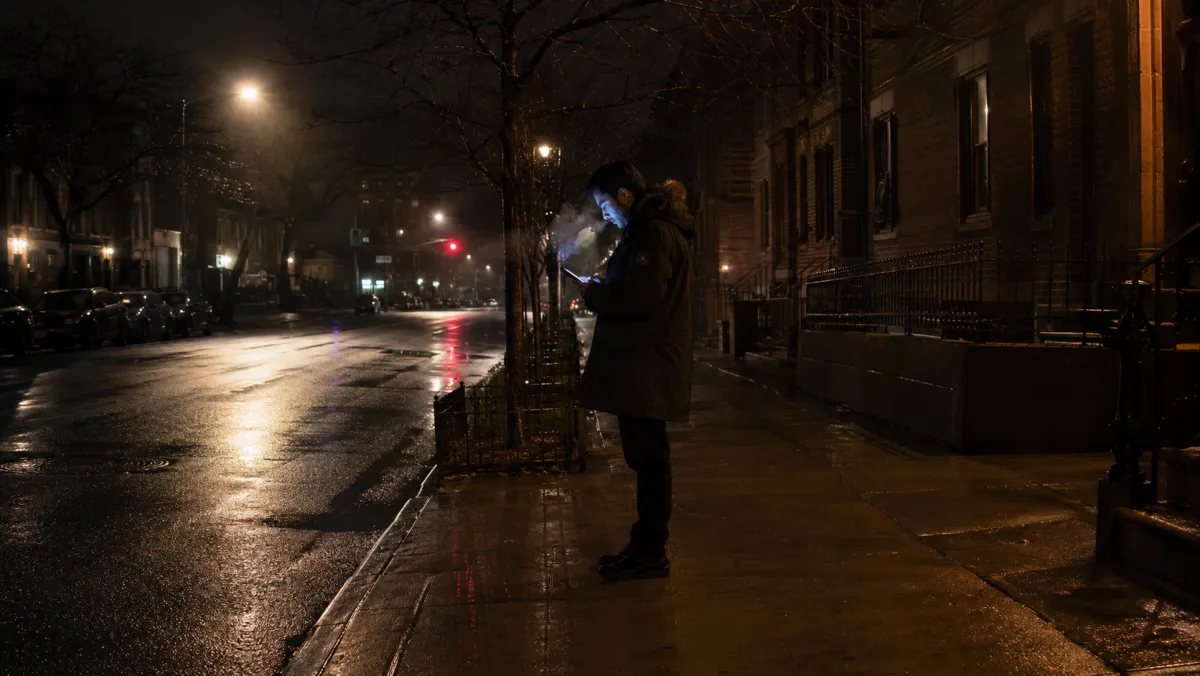
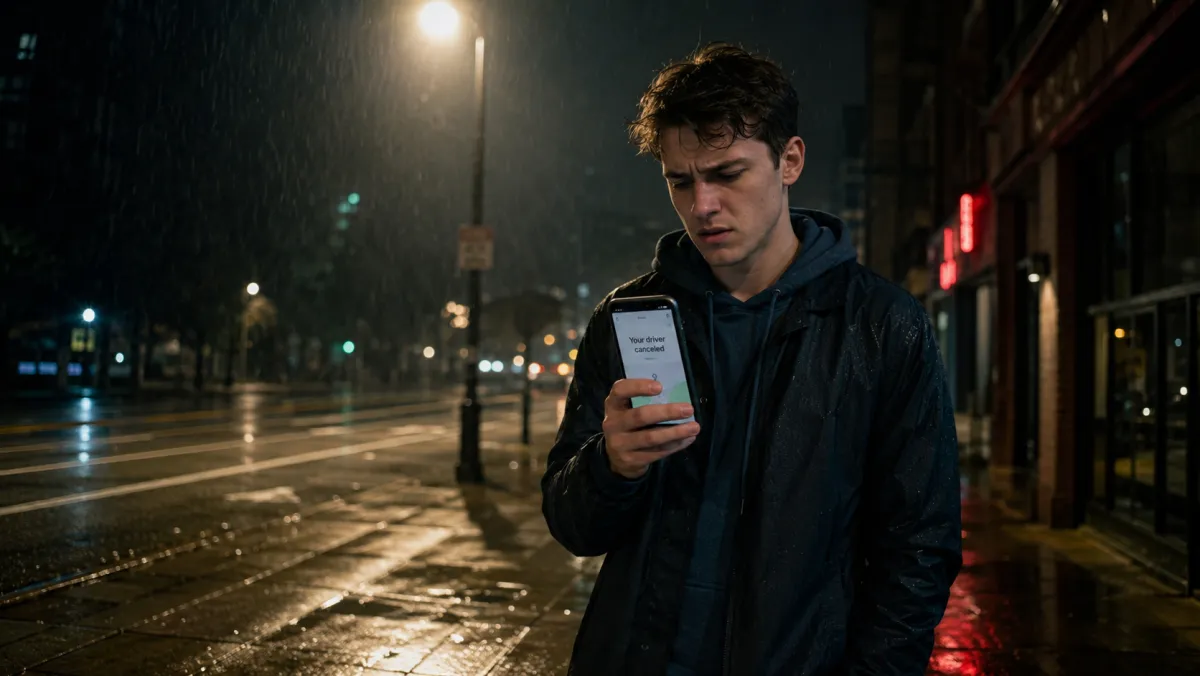
The first time I really understood that "Uber runs 24/7" is a marketing line and not an operational guarantee, I was standing on North 7th Street in Williamsburg at 3:42 AM on a Tuesday in February 2024. Nineteen degrees. I had just left a friend's birthday at Skinny Dennis. I opened the app. No cars available. I refreshed every thirty seconds for fourteen minutes. When a match finally came, the driver was seventeen minutes away in Long Island City. The whole way home he told me he had just logged on five minutes earlier because he couldn't sleep. I had basically gotten lucky.
I'm Vincent. I run RideWise, and that night is what this article is about. The official answer to "what time do Uber and Lyft stop running" is easy and not useful. The real answer — the one you need when you're standing on the curb at 3 AM in winter — is messier and a lot more specific to where you are.
The official answer (and why it doesn't help)
Both companies will tell you the same thing. Uber's Help Center says the platform is available 24/7 in supported cities. Lyft says the same: no scheduled service hours, the app accepts ride requests at any time. This is technically true. There is no clock at Uber HQ that gets switched off at 2 AM. The matching algorithm runs continuously.
The problem is the next sentence: if a driver is online and within range. Drivers are independent contractors. They log on and off whenever they want. And the data on when they actually log off is the story nobody tells you.
What actually happens — supply, not schedule
Uber and Lyft never officially "stop running" — both operate 24/7 in supported cities — but driver supply, not a schedule, determines whether you can actually get a ride. Supply follows a U-shaped curve: it peaks during morning (6:30–9 AM) and evening (5–7 PM) commutes and bottoms out roughly between 3 AM and 5 AM in most markets.
One thing that consistently shows up in our analysis of late-night surge patterns at RideWise is a U-shaped curve. Driver supply peaks twice — once during morning commute (6:30 to 9 AM) and once during evening (5 to 7 PM). This pattern is visible in the NYC TLC aggregated driver activity reports, which publish monthly active-driver counts by hour. It stays moderately high through bar-close, then falls off a cliff around 2:30 AM.
The bottom of that curve sits between 3 and 4:30 AM. This is the window where, in most American cities, your odds of getting a ride within ten minutes drop below 50%. The drivers who worked the dinner and bars-close shift have gone home. The early-morning airport drivers have not yet logged on. There is a real, measurable supply gap.
The NYC Taxi & Limousine Commission's aggregated reports are the best public dataset on this. TLC publishes monthly active driver counts and trip volumes by hour. The 3 to 5 AM window consistently shows the lowest active vehicle count of any time period — typically 15 to 25% of the peak evening count. And NYC is the easiest market in America. In cities without 24-hour business districts, the drop is much steeper.
Late-night reliability by city
The table below is based on RideWise's pickup-time analysis from January through April this year, cross-referenced with TLC data (for NYC) and our own field-tested experiments — meaning, my team and I actually opened the apps at 2 AM in these cities and recorded what happened. The "wait at 2 AM" column is the typical pickup time on a Tuesday or Wednesday night, not a Saturday.
| City | Late-night reliability | Typical wait at 2 AM (weeknight) | Effective cutoff |
|---|---|---|---|
| Las Vegas (Strip) | Excellent | 3–5 min | None — true 24/7 |
| New York (Manhattan) | Excellent | 4–7 min | None |
| New York (outer boroughs) | Good | 8–15 min | Soft cutoff ~3 AM |
| Los Angeles (Westside/DTLA) | Good | 6–10 min | None |
| Los Angeles (Valley/Eastside) | Moderate | 10–18 min | Patchy 3–5 AM |
| Chicago (Loop/River North) | Good | 5–10 min | None |
| Chicago (outer neighborhoods) | Moderate | 12–22 min | Effectively dead 3–4:30 AM |
| San Francisco | Moderate | 10–18 min | Thin 2–4 AM |
| Miami (Beach/Brickell) | Good | 5–12 min | None |
| Austin | Moderate | 10–20 min | Sparse 3–5 AM |
| Seattle | Moderate | 12–20 min | Thin after 2:30 AM |
| Atlanta | Moderate | 10–18 min | Patchy 3–5 AM |
| Denver | Fair | 15–25 min | Often unavailable 3–5 AM |
| Dallas | Fair | 12–22 min | Sparse 3–4 AM |
| Phoenix | Fair | 15–25 min | Often unavailable 3–5 AM |
| Portland, OR | Fair | 15–30 min | Often unavailable 3–5 AM |
| Nashville | Fair (better Fri/Sat) | 15–25 min | Often unavailable Sun–Thu after 3 |
| Indianapolis | Poor weeknights | 20–40 min or no match | Effectively closed 3–5 AM Sun–Thu |
| Cleveland | Poor weeknights | 20–40 min or no match | Effectively closed 3–5 AM Sun–Thu |
| Most college towns | Poor | Often no match | Driver supply dies ~11 PM Sun–Wed |
"Excellent" means I have never personally failed to get a ride. "Good" means it works almost always but you might wait. "Moderate" means it works most of the time but plan for fifteen minutes. "Fair" means you should have a backup plan. "Poor" means do not assume the app will work — make other arrangements before you go out.
When supply actually drops
Rideshare supply does not switch off at a fixed time — it tapers, with the effective late-night cutoff falling around 2:30–3 AM in most US cities and extending to 4–5 AM in dense nightlife markets like NYC, Las Vegas, and Miami. College towns and mid-size metros can drop to near-zero supply after 11 PM on weeknights.
The "effective cutoff" above is shorthand. The reality is that supply doesn't turn off at one specific time — it tapers. Different cities have different taper curves depending on nightlife density, downtown residential population, and how many full-time drivers work overnight.
| City | Peak late-night supply | Sharp drop starts | Trough (lowest) | Recovery starts |
|---|---|---|---|---|
| NYC (Manhattan) | 12 AM–2 AM | 3 AM | 4–4:30 AM (still usable) | 5 AM (airport runs) |
| Los Angeles | 11 PM–1:30 AM | 2:30 AM | 3:30–4:30 AM | 5 AM (LAX) |
| Chicago | 12 AM–2 AM | 2:30 AM | 3:30–4:30 AM | 4:45 AM (O'Hare) |
| San Francisco | 11 PM–1:30 AM | 2 AM | 3–4:30 AM | 5 AM (SFO) |
| Miami | 12 AM–3 AM | 3:30 AM | 4:30–5:30 AM | 6 AM (MIA) |
| Las Vegas (Strip) | Flat all night | Never (true 24/7) | N/A | N/A |
| Austin | 11 PM–2 AM | 2:30 AM | 3:30–5 AM | 5:15 AM (AUS) |
| Atlanta | 11 PM–1:30 AM | 2 AM | 3–5 AM | 5 AM (ATL) |
| Denver | 10 PM–1 AM | 1:30 AM | 2:30–5 AM | 5 AM (DEN) |
| Seattle | 10 PM–1 AM | 1:30 AM | 2:30–5 AM | 5 AM (SEA) |
Notice the pattern: almost every recovery point is tied to a major airport. The first early-morning airport flights (typically 5:30 to 6 AM departures requiring 4:30 to 5 AM pickup) pull drivers back online. If you can hold out until 5 AM, supply almost always rebounds. The window between 3 and 5 AM is where most of the suffering happens.
The bars-close surge — 1 AM to 2:30 AM
Before supply drops at 3 AM, there's a different problem: a roughly ninety-minute window where demand spikes faster than supply, creating predictable surge multipliers in nightlife cities. Last call across the US is mostly 2 AM, though Chicago is 2 AM weekdays / 3 AM weekends, NYC is 4 AM, and Vegas has no last call at all. The surge always centers on the relevant closing time.
I've logged these by hand across a year of weekend ride attempts. Numbers below are typical Friday or Saturday surge multipliers I've personally seen on Uber's app between 1:30 AM and 2:30 AM during my own attempts to leave bar districts.
| City / district | Typical surge window | Typical Uber multiplier | Typical Lyft Price Lock rate |
|---|---|---|---|
| NYC (LES, EV, Williamsburg) | 3:30–4:30 AM (4 AM last call) | 2.0x–2.8x | 1.4x–1.8x |
| Chicago (Wicker Park, River North) | 2–3 AM (weekend) | 1.8x–2.5x | 1.3x–1.7x |
| Austin (6th Street, Rainey) | 1:30–2:30 AM | 2.2x–3.0x | 1.5x–2.0x |
| Nashville (Broadway) | 1:30–2:30 AM | 2.5x–3.5x | 1.6x–2.2x |
| Miami Beach (Lincoln Rd, Ocean Dr) | 3–5 AM (5 AM last call) | 2.0x–3.0x | 1.5x–2.0x |
| LA (West Hollywood) | 1:30–2:30 AM | 2.0x–2.6x | 1.4x–1.8x |
| SF (SoMa, Mission) | 1:30–2:30 AM | 1.8x–2.5x | 1.3x–1.7x |
| Boston (Allston, Fenway) | 1:30–2:15 AM (2 AM last call) | 2.0x–3.0x | 1.5x–1.9x |
| Las Vegas (Strip) | Surge happens, but rarely intense | 1.4x–1.8x | 1.2x–1.5x |
Vegas is the outlier here too. Because supply is constant and demand is spread across the night (no synchronized last call), surge rarely gets brutal. Nashville is the worst on this list — Broadway empties out fifty thousand people in thirty minutes onto a handful of pickup zones, and the multiplier reflects it.
I wrote a much more detailed piece on this called how the Uber and Lyft surge algorithm actually works if you want the mechanics. Short version: waiting twenty minutes past the surge usually drops the multiplier 30 to 50%, but waiting too long puts you into the supply-collapse window. The sweet spot is usually leaving the bar at 1:15 AM, or after 2:45 AM. The 1:30 to 2:30 window is the single worst possible time to request.
The Vegas Strip exception
Las Vegas — specifically the Strip from Mandalay Bay up to Sahara — is the only American market where I'll tell people "yes, you can absolutely rely on rideshare at any hour, any day, with no plan B." I've tested it. Wednesday October at 3:17 AM. Match in ninety seconds.
Two reasons. Vegas is a 24-hour city by zoning — nothing is ever "closed for the night." Demand is continuous. And the Strip has more than 150,000 hotel rooms within a four-mile stretch, which means driver density per square mile is among the highest in the country. Drivers idle in the same parking structures and cycle through fares constantly.
The exception to the exception: if you're off-Strip — Henderson, Summerlin, North Las Vegas — supply behaves more like Phoenix or Salt Lake City. You can still get a ride, but expect 15 to 25 minutes after midnight.
The college town reality
This is the section I want parents and students to read. Rideshare in college towns is unreliable after about 11 PM on weeknights, and I've personally seen the supply go to literally zero in towns like Ithaca, Bloomington, and State College. Friday and Saturday are slightly better because of the bar surge bringing drivers out, but on a Tuesday in February at midnight in Champaign, Illinois, you may simply not be able to get a ride.
The math is brutal. In a college town of 80,000 people, you might have 30 to 50 active drivers at peak — and five to eight at 2 AM on a weeknight. If three of those eight are already on rides and two are positioned in the wrong part of town, you're functionally trying to match with three cars covering forty square miles.
If you're a student or visiting a student: pre-plan late-night transportation. Most schools have a safe-ride program (free van service that runs until 2 or 3 AM). Use that. Save it in your contacts before you go out.
Friday vs Tuesday
Across every market I've tracked, driver supply at 2 AM on Friday or Saturday is roughly 2.5 to 4 times the supply at 2 AM on Tuesday or Wednesday. This is because weekend nights are when full-time drivers maximize earnings — surge is reliable, tips are higher, and many part-time drivers who only work weekends are online.
Practical implication: a city that's "Moderate" in my reliability table on a Saturday might be "Poor" on a Wednesday at the same hour. If you're traveling for business and getting back from a dinner at midnight on a Tuesday in Cleveland, don't assume the app will work the way it would on a Saturday.
Most rideshare drivers are part-time and work peak hours only. The full-timer base — drivers who do 50+ hours a week — is what carries weeknight late-night service. There are roughly three to four times fewer full-timers than peak-hour drivers in most US markets. Sunday through Thursday after 2 AM, you're essentially relying on that smaller pool.
If no driver matches
I've been in this situation more times than I can count. Here's the exact sequence I run through, in order.
First, cancel and re-request after five minutes. The matching algorithm sometimes gets stuck searching at a narrow radius. A fresh request resets the search and often pulls in a driver who was just outside the original radius. Don't cancel and re-request immediately — wait five full minutes so you don't get a cancellation fee and a new driver pool becomes available.
Try the other app. Driver pools overlap maybe 60 to 70% — most drivers run both apps, but not all. If Uber shows nothing, Lyft sometimes has a driver. The reverse is also true. This costs you thirty seconds and works surprisingly often. (I cover the same trick for cheaper rides in my piece on the best time to book Uber and Lyft.)
Walk toward a busier zone. Drivers idle near hospitals, hotels, late-night diners, and downtown cores. If you're in a quiet residential area at 3 AM, walking four to six blocks toward a hotel cluster can be the difference between a 25-minute wait and a 6-minute match. Set your pickup location to a hotel lobby or 24-hour diner if there's one nearby — drivers are more likely to accept requests at addresses they recognize.
Try a regular taxi. Cabs still exist, and in cities like NYC, Chicago, Boston, and Vegas they actually run 24/7 by city regulation. Curb is the app for hailing a yellow/legal taxi in most US cities and works at hours when Uber and Lyft are sparse. Most cabs accept credit cards now — that excuse stopped being valid around 2014.
Hotel shuttles, late-night transit, scooters. Many big-city hotels run a free airport or downtown shuttle until 2 AM. NYC has 24-hour subway service. Chicago's Blue and Red lines run 24 hours. Revel mopeds (in NYC, DC, San Francisco, Miami) and Lime scooters in most major cities operate until midnight or 2 AM depending on city.
And if it's 3:30 AM and nothing is working, the smartest move is often to wait until 4:45 or 5 AM when the airport-driver wave brings supply back. Find a 24-hour diner, a hotel lobby, or a gas station with seating. Do not stand alone on a dark street refreshing your phone.
Airports late at night (usually fine)
One of the most common questions I get is "will I be able to get an Uber from the airport at 2 AM?" Almost always yes. Airports are the one place where late-night rideshare is reliable in nearly every US market, because they have dedicated driver staging lots — drivers sit in queue waiting for flights to land — and overnight demand from delayed and red-eye flights is constant enough to justify the wait.
I've personally tested LAX, JFK, ATL, ORD, DEN, SFO, MIA, LAS, SEA, and BOS at hours between midnight and 4 AM. Wait times have always been under twelve minutes, usually under six. The only consistent exception is very small regional airports (think Burlington, VT or Bismarck, ND) where the last commercial flight lands at 10 PM and drivers go home. If you can, check our airport rideshare pricing guide for what to expect for your specific airport.
Late-night safety, concretely
I'll keep this concrete because safety advice usually drifts into platitudes. Here's what actually matters at 3 AM.
Verify before you get in. The driver photo and license plate must match what the app shows. Both Uber and Lyft now require a four-digit PIN match in some cities — use it. If you ever have to ask "are you my Uber?" you shouldn't get in. Ask the driver "who are you here for?" and let them say your name first.
Share your trip. Both apps have a one-tap Share trip button that sends your live route and ETA to a contact. Use it every time at night. If something goes wrong, your friend has the driver's name, plate, and route.
Sit in the back, on the passenger side. This gives you the most exit options and the most visibility of the driver. Don't get in if the driver seems impaired — late-night drivers are often on hour twelve of a shift. If they smell like alcohol, are visibly nodding off, or refuse to follow GPS, cancel the trip from inside the car and request a different ride. Both companies will refund the cancellation.
If you're drunk, don't ride alone. Travel with a sober friend, or ask a bar bouncer or hotel concierge to confirm your pickup. There have been documented cases — including ones covered by Reuters and the New York Times over the years — of bad actors impersonating rideshare drivers near bar districts at last call.
Both apps have an in-app 911 button that auto-sends your location and trip info to the dispatcher. Know where it is before you need it. And take a screenshot of your driver's license plate, name, and photo as soon as the match comes through — if anything goes wrong, you have it offline. I've done this on every late-night ride for years.
The driver shortage thing
You may have read coverage over the past few years about a "rideshare driver shortage." The reality is more nuanced. According to industry reporting from outlets like the Wall Street Journal and the Bureau of Labor Statistics, total driver counts on both platforms have largely recovered to pre-pandemic levels in major metros — but the distribution has shifted. More drivers are part-time, more do deliveries (Uber Eats, DoorDash) instead of rides, and fewer are willing to work the unprofitable overnight shifts.
The net effect: peak-hour service is fine. Off-peak service, especially late nights in mid-sized cities, is worse than it was in 2019. The 2 AM Tuesday driver pool in Indianapolis today is roughly half what it was six years ago. This is a real, measurable change, and it's why "Uber runs 24/7" feels less true than it used to.
A few more late nights in NYC
A few specific moments shaped how I think about this.
March 2023, Lower East Side. 2:55 AM on a Friday. Six of us trying to get from Pianos to my apartment in the West Village. Surge was 3.1x. I made everyone wait twenty-five minutes drinking water at a 24-hour deli. By 3:20 AM surge was 1.2x. We split into two Lyfts. The whole group saved about ninety bucks versus requesting at 2:55.
July 2024, JFK. Flight landed at 1:35 AM. I was the only person in my friend group who'd read the Uber pickup signs carefully — the rideshare lot at JFK is in a specific location (lot 6, then bus to terminal) and people who request from the curb get wildly long waits. I requested from the rideshare lot the moment I cleared customs. Match in four minutes. Friends on a different flight, who requested from baggage claim, waited twenty-eight minutes.
February 2025, Stamford, CT. 1:45 AM on a Sunday after a wedding. Total dead zone. Three of us tried both apps for thirty-five minutes. Nothing. We ended up walking into a Hilton lobby and asking the night concierge to call a local cab company. The cab was there in twelve minutes. The lesson I took: in any town smaller than ~250,000 people, have the number for a local cab dispatch saved before you go out.
November 2025, Williamsburg again. Same neighborhood as the opening anecdote. 3 AM. This time I knew the move: walked six blocks south to the McCarren Park area where night-shift drivers idle waiting for Manhattan-bound trips. Match in three minutes. The information from a year of getting this wrong was worth the walking.
Alternatives when nothing works
| Alternative | Where it works late night | Typical cost | Best for |
|---|---|---|---|
| Traditional taxi (Curb app or street hail) | NYC, Chicago, Boston, SF, DC, Philly, Vegas | Similar to base UberX, no surge | 2–5 AM in big cities; reliable when Uber is not |
| Revel rideshare | NYC (Manhattan) | ~15% under UberX | Late-night Manhattan, 24/7 with stable supply |
| Hotel shuttle | Most major hotels; usually until 2 AM | Free if hotel guest | Airport hotel runs, downtown returns |
| Late-night transit | NYC (24h), Chicago Blue/Red (24h), SF Owl bus, LA night bus | $2.75–$5 | Budget option; not great for solo women per safety guidance |
| Scooter/moped (Revel, Lime, Bird) | Most major cities, typically until midnight or 2 AM | $3–$15 | Short hops under 3 miles |
| Walking | Anywhere safe under 1.5 miles | Free | Short distances in busy areas; avoid solo if drunk |
| Local cab dispatch (call directly) | Every US city; smaller cities especially | Often 10–20% over UberX | Mid-sized and small cities; the underrated backup |
| Wait at a safe 24-hour spot | Anywhere | Free / cost of coffee | Wait out the 3–5 AM trough; supply rebounds at 5 |
What the companies won't tell you
Both Uber and Lyft have a strong incentive to present the service as 24/7 and reliable. That's the brand promise. But anyone who has actually tried to use rideshare at 3 AM in a mid-sized city knows the reality is messier. The companies do not publish driver-supply-by-hour data publicly. They don't show "expected wait" until after you've opened the app and requested. They don't tell you that your specific neighborhood has 30% the driver density of the neighborhood three miles away.
The closest you get to honest data is the NYC TLC, which is legally required to publish it, and academic studies that scrape app data. Both confirm what I see in the field: there's a real, predictable 2-to-4-hour window each night where service in most American cities degrades from "great" to "patchy" to, in some places, "do not bother."
None of this is me telling you not to use Uber and Lyft late at night. I use them constantly. It's me telling you to plan as though supply might fail, especially outside the top five or six metros, especially on weeknights. If you have a backup plan, the apps work fine 95% of the time. If you don't, the 5% that they fail can be miserable and occasionally unsafe. (Two related pieces worth bookmarking before a late night out: the payments guide if you might need a cash backup, and the driver ratings explainer if you're wondering why a particular driver canceled on you.)
Stay safe out there.
Read Next
Frequently Asked Questions
Do Uber and Lyft run 24 hours a day?
Officially yes — in most US metro areas, both Uber and Lyft operate 24/7 with no scheduled cutoff. The unofficial truth is that driver supply collapses in many cities between roughly 2 AM and 4 AM, especially Sunday through Thursday. You may open the app at 3 AM in Cleveland or Indianapolis and see "no cars available" even though the service is technically running.
What time do Uber drivers typically stop driving?
Driver supply drops dramatically after the bars-close surge ends — usually around 2:30–3 AM. Most full-time drivers end their shift between 2 and 4 AM, and the next wave (early-morning airport drivers) does not come online until 4:30–5 AM. That gap is the dead zone where you may wait 15–30 minutes for a match in a mid-sized city.
Why does Uber say no cars are available at 3 AM?
Three reasons stacked together: most drivers have logged off after the post-bar surge, the drivers still online have already accepted a ride and are not visible to you, and the algorithm widens the search radius slowly. Cancel and re-request five minutes later, walk toward a busier zone, or open the Lyft app — driver pools partly overlap but never fully.
Is it safe to take Uber or Lyft late at night?
Yes, with normal precautions. Always verify the license plate and driver photo before getting in, check that the app shows the correct driver name, share your trip with a friend through the in-app share button, sit in the back seat, and never get in a car the driver says is an Uber if it didn't match the app. Both Uber and Lyft now offer in-app 911 buttons and trip recording in many cities.
What city has the most reliable late-night Uber service?
The Las Vegas Strip is the most reliable late-night rideshare market in the US — driver supply is essentially flat 24/7 because the city itself runs 24/7. After Vegas, the most reliable late-night markets are Manhattan, West Hollywood / Downtown LA, the Chicago Loop, and Miami Beach. Smaller cities and college towns can become functionally unusable between 2 and 5 AM on weeknights.
What should I do if no Uber or Lyft will come?
In order: cancel and re-request after five minutes; check the other app (driver pools overlap maybe 60%); walk four to six blocks toward a denser zone (downtown, hotel cluster, hospital); try Curb or a local taxi dispatcher; check for hotel shuttles or late-night transit; only as a last resort, wait it out somewhere safe and well-lit until 5 AM when the early-morning airport wave starts.
Ready to start saving?
Compare Uber, Lyft, and taxi prices side-by-side in seconds. Free, no sign-up required.
Compare Prices Now