
Short answer: Lyft is not always more expensive than Uber, but it often is now. Here is what the same routes at the same hour looked like in New York City in July 2026:
- Lyft's cheapest rides cost 3.8% more than Uber's cheapest rides.
- Outside Manhattan, Lyft's cheapest rides cost 7–8% more than Uber's.
- A year ago, Lyft's typical fare was 6.2% below Uber's. Now the two are about the same.
- Lyft still wins in Midtown Manhattan, where its cheapest fares run 13–17% lower, and on rides under a mile.
Most Uber vs Lyft price comparisons, including ours, start from each app's published rates. This one does not. New York City's Taxi and Limousine Commission (TLC) publishes a record of every Uber and Lyft trip taken in the city: where it started, where it ended, how long the rider waited, what they paid, what they tipped and what the driver got. It is the only US city that does this with the company named on each trip. Chicago publishes rideshare trips too, but without saying which app each one used.
We analyzed 263 million of those trips, from July 2025 to July 2026. It is the clearest evidence we know of for why Lyft is more expensive than Uber on some trips and cheaper on others. It also answers a question rate cards can't: which app actually gets to you faster.
How We Compared Uber and Lyft Fairly
A plain average would be misleading. Uber has about 72% of NYC trips, and the two apps are not busy in the same places or at the same times. So we compared like with like.
- Same route, same hour. We grouped trips by pickup zone, drop-off zone and hour of the day. NYC has 263 taxi zones, so a "route" is roughly neighborhood to neighborhood. We kept a group only if both apps had at least 20 trips in it that month.
- Two prices per group. The typical fare is the middle fare. The budget fare is the cheapest 10% of fares. We report both because the trip records don't say which ride type was booked. A group of Uber trips can include UberX, UberXL and Uber Black. The cheapest 10% is mostly each app's lowest-priced ride, so it is the fairest test of which app is cheaper for a price-conscious rider.
- Fare before extras. Unless we say "all-in", fares are before tolls, tips, taxes and fees. Those extras are set by the state and city and are almost the same on both apps.
The full method and its limits are at the end of this article.
Lyft's New York Discount Has Been Shrinking
Lyft used to be the cheaper app in New York. In the first three months of our data, its typical fare averaged 6.6% below Uber's on the same route and hour. In the last three months, the gap averaged 2.5%. In March, April and July 2026 it was close to zero.
The change did not happen in a straight line, and the gap still bounces from month to month. Lyft was cheaper on most routes in 10 of the 13 months. But the trend is clear, and it is driven by Lyft. Comparing July 2025 with July 2026 on the same routes and hours:
- Lyft's typical fare rose 7.1%. Uber's rose 1.7%.
- Lyft's cheapest fares rose 4.3%. Uber's cheapest fares fell 1.7%.
Rising driver pay does not explain the gap. The TLC's minimum pay rates for both apps rose 3.36% on March 1, 2026 (Industry Notice #26-03). Pay on the same trips actually grew faster at Uber (5.3%) than at Lyft (3.2%). The records can't tell us why Lyft priced up, and Lyft doesn't publish its NYC rates. What they can tell us is where the change hits riders.
Why Is Lyft More Expensive Than Uber? 4 Patterns in the Data
1. You are outside Manhattan
This is the biggest one. In every borough except Manhattan, Uber's cheapest rides now beat Lyft's.
| Borough | Typical fare | Budget fare | Cheaper budget ride | Typical, a year ago |
|---|---|---|---|---|
| Manhattan | −8.5% | −2.9% | Lyft | −14.2% |
| Brooklyn | +5.7% | +7.6% | Uber | −1.7% |
| Queens | +2.6% | +6.7% | Uber | −1.9% |
| Bronx | +3.9% | +8.1% | Uber | +0.6% |
| Staten Island | +4.7% | +6.8% | Uber | +6.0% |
Source: RideWise analysis of NYC TLC High-Volume For-Hire Vehicle trip records. Fares before tolls, tips, taxes and fees.
Brooklyn saw the biggest swing. A year ago Lyft's typical fare there was 1.7% below Uber's. Now it is 5.7% above. In central Brooklyn neighborhoods like Crown Heights, Stuyvesant Heights, Ocean Hill and Brownsville, Uber's cheapest fares are about 11–13% lower than Lyft's.
2. Your ride is 2 to 8 miles
Distance changes the answer a lot. On rides of 2 to 8 miles, Uber's budget fare beats Lyft's by 11–18%. That covers a large share of everyday trips across Brooklyn and Queens.
| Distance | Typical fare | Budget fare | Cheaper budget ride |
|---|---|---|---|
| Under 1 mile | −6.8% | −8.9% | Lyft |
| 1–2 miles | +0.5% | +1.0% | About even |
| 2–3 miles | +4.1% | +11.2% | Uber |
| 3–5 miles | +6.1% | +17.7% | Uber |
| 5–8 miles | +1.8% | +15.1% | Uber |
| 8–12 miles | −7.7% | −1.3% | About even |
| 12–20 miles | −9.6% | −1.9% | Lyft |
| Over 20 miles | −10.2% | +0.7% | About even |
On longer rides, Lyft's typical fare looks much cheaper, but its budget fare is close to Uber's. The difference is ride type. More Uber riders on long trips pick XL or Black, which pushes Uber's middle fare up. If you are booking the cheapest car on each app, long rides are close to a tie.
3. Uber's cheapest option got cheaper
Over the year, Uber's cheapest fares on the same routes fell 1.7% while its typical fare rose 1.7%. That gap between Uber's bottom and middle points to one feature: Wait & Save. Uber describes it as a way to "pay less for an UberX ride during surge, in return for a longer wait time." Lyft has its own Wait & Save. The wait-time data below suggests Uber's version is doing much more to lower prices in New York.
4. You ride in the evening
Time of day matters less than place, but it shows up.
| Time requested | Typical fare | Budget fare |
|---|---|---|
| Midnight–6 a.m. | −2.4% | +2.4% |
| 6–10 a.m. | −0.2% | +4.3% |
| 10 a.m.–4 p.m. | −1.3% | +0.6% |
| 4–8 p.m. | +1.0% | +4.7% |
| 8 p.m.–midnight | +1.1% | +7.8% |
Lyft's budget fare is highest compared with Uber's in the evening, from 8 p.m. to midnight. Midday is closest to even. For more on timing, see the cheapest times to book Uber and Lyft.
Why Is Lyft Cheaper Than Uber? Where Lyft Still Wins
Lyft has not lost everywhere. The map shows where each app's cheapest ride costs less.
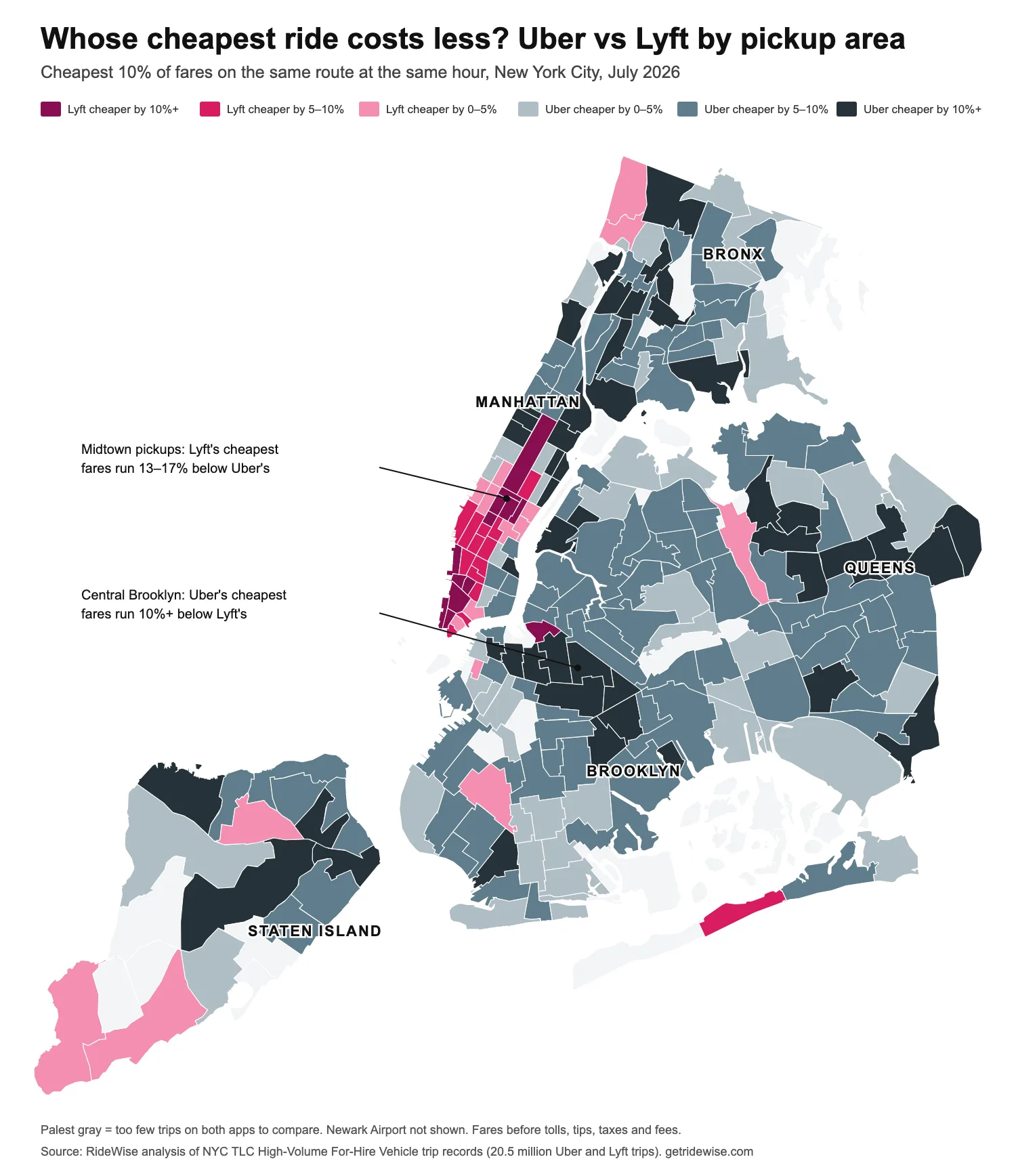
- Midtown and Lower Manhattan. For pickups in Midtown and around Times Square, Lyft's cheapest fares ran 13–17% below Uber's. Across all of Manhattan, Lyft's typical fare was 8.5% lower.
- Very short rides. On rides under a mile, Lyft's budget fare was 8.9% below Uber's.
- Airport trips, at the typical fare. On trips to or from JFK and LaGuardia, Lyft's typical fare was 6.3% lower. At the budget end the gap was 0.8% the other way, so the big difference is partly Uber riders choosing bigger or nicer cars.
Heading to the airport? Our guides to LaGuardia to Manhattan and JFK to Manhattan compare both apps with the bus, train and taxi.
What Riders Paid on 8 Busy NYC Routes
Here is the typical all-in fare on some of the city's busiest routes. All-in means the fare plus tolls, taxes and city fees such as the congestion charges, but not the tip. These are all hours combined, so they mix busy and quiet times.
| Route | Typical distance | Uber | Lyft | Cheaper |
|---|---|---|---|---|
| Midtown Center → JFK Airport | 17.2 mi | $141.38 | $114.00 | Lyft by $27.38 |
| Times Sq/Theatre District → LaGuardia Airport | 10.3 mi | $92.09 | $70.98 | Lyft by $21.11 |
| LaGuardia Airport → Times Sq/Theatre District | 9.4 mi | $97.54 | $85.57 | Lyft by $11.97 |
| JFK Airport → Times Sq/Theatre District | 17.9 mi | $132.58 | $114.67 | Lyft by $17.91 |
| Upper East Side South → Midtown Center | 1.2 mi | $27.21 | $20.96 | Lyft by $6.25 |
| Within Crown Heights North | 1 mi | $9.95 | $9.99 | About even |
| Crown Heights North → Canarsie | 3.7 mi | $22.78 | $26.92 | Uber by $4.14 |
| Astoria → LaGuardia Airport | 4 mi | $25.72 | $26.95 | Uber by $1.23 |
Source: RideWise analysis of NYC TLC trip records. Middle (median) fare for all Uber and Lyft trips between these taxi zones. Ride types are mixed, and airport-route Uber fares include more XL and Black trips.
Want a number for your own trip? The Uber price estimate calculator and Lyft fare calculator work without logging in, and Compare Uber and Lyft prices shows both side by side.
Uber vs Lyft Wait Times: Who Picks You Up Faster?
Price is only half of it. The trip records also show how long each rider waited from tapping "request" to getting in the car. Unlike surveys or screenshots, this look at Uber vs Lyft wait times uses every trip in the city.
For a typical ride, Uber is a little faster. The median Uber rider was picked up 4.3 min after requesting, against 4.6 min on Lyft. On matching pickup areas and hours, Uber was faster 71% of the time.
But Uber has more long waits. 11% of Uber rides took more than 10 minutes, against 6% on Lyft. A year ago both apps were at 5%.
| Pickup area | Uber median | Lyft median | Uber 10+ min | Lyft 10+ min |
|---|---|---|---|---|
| Manhattan | 4.0 min | 4.4 min | 7% | 6% |
| Brooklyn | 4.6 min | 4.6 min | 12% | 5% |
| Queens | 4.9 min | 4.8 min | 14% | 8% |
| Bronx | 5.0 min | 5.1 min | 15% | 7% |
| Staten Island | 5.5 min | 5.5 min | 19% | 11% |
| JFK Airport | 6.1 min | 6.0 min | 22% | 25% |
| LaGuardia Airport | 6.9 min | 5.6 min | 27% | 15% |
Medians are averaged over matching pickup zones and hours. Source: RideWise analysis of NYC TLC trip records.
At LaGuardia, Lyft was clearly faster, 5.6 min against 6.9 min for Uber. At JFK the two were close.
Long waits: a discount on Uber, a warning sign on Lyft
We compared each rider's fare with the typical fare on the same route and hour, grouped by how long they waited. The two apps behave in opposite ways.
| Wait | Uber fare | Share of Uber rides | Lyft fare | Share of Lyft rides |
|---|---|---|---|---|
| Under 3 min | +0.0% | 29% | −1.6% | 22% |
| 3–5 min | +1.3% | 32% | −0.5% | 36% |
| 5–8 min | +0.1% | 22% | +0.5% | 29% |
| 8–10 min | −2.8% | 7% | +4.4% | 7% |
| 10–15 min | −5.1% | 7% | +6.6% | 5% |
| 15+ min | −4.0% | 3% | +8.1% | 1% |
Uber riders who waited 10 to 15 minutes paid about 5% less than normal. Lyft riders who waited that long paid about 7% more. The records don't say who picked Wait & Save, so we can't prove the cause. But the pattern fits: many slow Uber pickups look like riders trading time for a lower price, while slow Lyft pickups look like busy periods when prices are high anyway. See how surge pricing works for why busy times push fares up.
Where Your Fare Goes: Driver Pay and Tips
- Driver share. In July 2026, Uber drivers received 77% of the fare before extras, and Lyft drivers 75%. A year earlier it was 77% at Uber and 79% at Lyft. So Lyft's higher prices did not mostly go to drivers.
- Tips. Lyft riders tip more often: 22% of Lyft rides had a tip, against 19% on Uber. Tips added 5.3% to Lyft fares and 4.4% to Uber fares overall.
For how pay works in other cities, see how much of your Uber fare goes to the driver. For how much to tip, see the rideshare tipping guide.
Does This Apply Outside New York?
We can't measure other cities this way, because no other city publishes trips by company. New York also has rules found nowhere else, including a minimum driver pay rate and the Manhattan congestion charges. So treat these results as New York results.
Some lessons do travel. The cheaper app can change with the neighborhood, the distance and the hour. And the cheapest option on each app, such as Wait & Save, matters more than the headline price. For estimates in 26 other metro areas, see our Uber vs Lyft comparison by city and when Uber is cheaper than Lyft.
How to Pay Less, Based on What the Data Shows
- Check the pickup area. In Midtown or Lower Manhattan, open Lyft first. In the outer boroughs, open Uber first.
- Think about the distance. For rides of about 2 to 8 miles, Uber's cheapest option usually wins. Under a mile, Lyft usually wins.
- Use Wait & Save when you can wait. In the data, Uber riders who waited 10 to 15 minutes paid about 5% less.
- Always open both apps. Lyft was cheaper on 48% of matched routes and hours, so neither app wins by default.
- Book the lower upfront price. Both apps show it before you confirm.
Method, and what these numbers are not.
- Data. NYC TLC High-Volume For-Hire Vehicle trip records, July 2025 to July 2026. License HV0003 is Uber and HV0005 is Lyft, per the TLC data dictionary. 263 million trips after cleaning.
- Cleaning. We kept trips of 0.3 to 60 miles and 2 minutes to 3 hours with a fare above zero. We dropped shared-ride requests and MTA Access-A-Ride trips.
- Comparison. Groups are pickup zone × drop-off zone × hour. A group needs at least 20 trips on each app. Gaps are weighted by trips. In July 2026, matched groups covered 13 million trips.
- Fares. The TLC's "base passenger fare" is the fare before tolls, tips, taxes and fees. We can't see promo codes or memberships. Ride types are not labeled, which is why we show a budget fare as well as a typical fare.
- Waits. Time from request to pickup. The TLC's "driver arrived" field is documented only for wheelchair-accessible trips, so we did not use it.
- Updates. The TLC publishes new months about two months late. We will rerun the same analysis and update this page as they come out.
RideWise is not affiliated with Uber, Lyft or the TLC and earns nothing from either app.
Frequently Asked Questions
Why is Lyft more expensive than Uber?
In New York City, where every trip is public, Lyft is often more expensive now because it raised prices faster. On the same route at the same hour, Lyft's typical fare rose 7.1% from July 2025 to July 2026, against 1.7% for Uber, and Uber's cheapest fares fell 1.7%. Outside Manhattan, Lyft's cheapest rides now cost 7–8% more than Uber's.
Why is Lyft cheaper than Uber sometimes?
Lyft still wins in Manhattan, especially for Midtown pickups, where its cheapest fares ran 13–17% below Uber's in July 2026. It is also cheaper on rides under a mile, by 8.9% at the budget end.
Is Lyft cheaper than Uber in NYC?
Not overall anymore. In July 2026 Lyft's typical fare was about the same than Uber's on matched routes, and its cheapest fares were 3.8% higher. A year earlier Lyft was 6.2% cheaper. It depends on where you are: Lyft wins in Manhattan, and Uber wins in most of Brooklyn, Queens and the Bronx. See our <a href="/us/new-york/new-york">New York price guide</a> for estimates.
Is Uber faster than Lyft?
For a typical pickup, slightly. The median NYC Uber rider was in the car 4.3 min after requesting, against 4.6 min on Lyft. But 11% of Uber rides took more than 10 minutes, against 6% on Lyft. Many of those slow Uber rides were cheaper, which suggests riders chose to wait for a lower price.
What is the average Uber wait time in NYC?
The median time from request to pickup was 4.3 min for Uber and 4.6 min for Lyft in July 2026. 58% of Uber riders and 57% of Lyft riders were picked up within 5 minutes.
Is Lyft cheaper than Uber to JFK or LaGuardia?
At the typical fare, yes: Lyft ran 6.3% below Uber on airport trips. At the budget end the two were close to even, so compare both apps. Lyft also picked up faster at LaGuardia (5.6 min vs 6.9 min).
Where does this data come from?
From the NYC Taxi and Limousine Commission, which publishes a record of every Uber and Lyft trip in the city. Each record names the company and includes the pickup and drop-off zone, times, miles, fare, tip and driver pay. RideWise analyzed 263 million trips from July 2025 to July 2026.
Ready to start saving?
Compare Uber, Lyft, and taxi prices side-by-side in seconds. Free, no sign-up required.
Compare Prices Now